what does a water table have to do with groundwater
What is Groundwater?
When rain falls to the footing, some of it flows along the state surface to streams, rivers or lakes, some moisturizes the ground. Role of this h2o is used by vegetation; some evaporates and returns to the atmosphere. Part of the water besides seeps into the ground, flows through the unsaturated zone and reaches the water table, which is an imaginary surface from where the footing beneath is saturated (meet analogy below).
That concluding i is Groundwater: all water found below the ground surface in the saturated zone.
Groundwater is contained in what are called 'aquifers'. An aquifer is a geological formation or role of information technology, consisting of permeable material capable to store/yield significant quantities of water. Aquifers can consist of unlike materials: unconsolidated sands and gravels, permeable sedimentary rocks such as sandstones or limestones, fractured volcanic and crystalline rocks, etc.
Groundwater is (naturally) recharged by rain water and snowmelt or from water that leaks through the lesser of some lakes and rivers. Groundwater also tin be recharged when h2o supply systems leak and when crops are irrigated with more h2o than required. There are also techniques to manage aquifer recharge and increment the amount of water infiltrating into the ground.
Groundwater can be found almost everywhere. The water table may lie deep or shallow depending on several factors such every bit the concrete characteristics of the region, the meteorological conditions and the recharge and exploitation rates. Heavy rains may increase recharge and cause the h2o table to rise. Simply in the other hand, an extended catamenia of dry weather may cause the h2o tabular array to autumn.
When groundwater reaches an aquifer it does not stand withal. It normally will go on flowing but much slower than earlier reaching the aquifer. How fast groundwater flows depends on the characteristics of the aquifer. The direction information technology moves is ordinarily from high to lower levels ruled by gravity, unless at that place is any anthropogenic affect such as pumping wells. The groundwater will move until it discharges into another aquifer or another water body similar a lake, a river, the ocean or until information technology is extracted by a well.
To be able to store and yield groundwater, an aquifer needs to have certain physical characteristics. It needs to have empty infinite (pores or fractures) where groundwater can exist stored and the spaces need to be connected to permit it to period through. Technically speaking, when there are spaces and they are interconnected the geological formation is permeable. When in that location are no spaces or they are not interconnected, the geological formation is impermeable. The greater the aquifer's porosity and permeability are, the more groundwater is stored and yield by an aquifer.
Why is groundwater then important?
Groundwater represents nearly 30% of globe's fresh water. From the other 70%, nearly 69% is captured in the ice caps and mountain snow/glaciers and merely ane% is found in river and lakes. Groundwater counts in average for ane third of the fresh water consumed past humans, but at some parts of the world, this percentage tin accomplish up to 100%. In the analogy bellow an overview is given of Earth's water distribution.
Groundwater is a very important natural resource and has a pregnant role in the economy. Information technology is the main source of water for irrigation and the food industry. In general groundwater is a reliable source of water for the agronomics and can be used in a flexible manner: when it's dry and there is larger need more than groundwater can be extracted and when the pelting fall meets the necessities, less groundwater will need to be extracted. Globally, irrigation accounts for more than 70% of total h2o withdraw (both surface and groundwater). Groundwater is estimated to be used for circa 43% of the total irrigation h2o use.
For the environment groundwater plays a very important function in keeping the water level and flow into rivers, lakes and wetlands. Especially during the drier months when there is little direct recharge from rainfall, information technology provides the environment with groundwater flow through the bottom of these water bodies and becomes essential for the wild life and plants living in these environment. Groundwater too plays a very relevant function in sustain navigation through inland waters in the drier seasons. By discharging groundwater into the rivers it helps keeping the water levels higher.
Groundwater is found almost everywhere and its quality is usually very expert. The fact that groundwater is stored in the layers beneath the surface, and sometime at very high depths, helps protecting it from contamination and preserve its quality. Additionally, groundwater is a natural resource which can often be plant close to the concluding consumers and therefore does non crave big investments in terms of infrastructure and treatment, as it often is necessary when harvesting surface water. The most of import well-nigh using groundwater is to find the right balance between withdrawing and letting the aquifer'south level recover to avoid overexploitation and to avoid pollution of this crucial resources.
Sources
- USGS – The World'southward H2o
- USGS – What is Groundwater - D.W. Clark and D.W. Briar. Open-File Written report 93-643, reprinted April 2001
- NGWA - Groundwater Fundamentals
- The importance of groundwater - D - LONGWOOD UNIVERSITY

In Africa, more people take access to a mobile phone (93%) than to piped water (63%) (Afrobarometer, 2016)

2-thirds of the Globe's groundwater is abstracted in Asia(UN WWDR 2012)
World'southward aggregated groundwater brainchild is 1,000 km3 per year
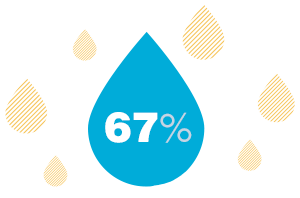
67% of all groundwater is used for irrigation (food production)
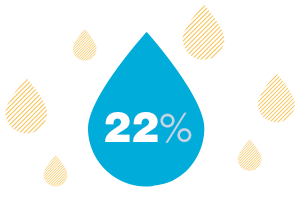
22% of all groundwater is used for domestic purposes (drinking h2o and sanitation)
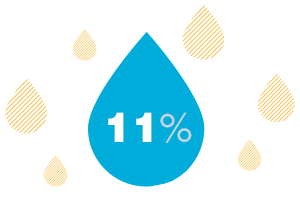
xi% of all groundwater is used for industry
Source: https://www.un-igrac.org/what-groundwater

Post a Comment for "what does a water table have to do with groundwater"